Picmon Devlog: From Card Game to RPG
Discover how PicMon evolved from a card game into a full RPG in just months. Learn the developer's pivot strategy, rapid iteration approach, and what's next for this photo-to-monster pet battle game.
By plec · June 30, 2026

I started PicMon at the end of April. It’s now Jun 26, 2026, and the game looks almost nothing like what I originally envisioned. Don’t get me wrong, that’s not necessarily a bad thing, but it can be difficult as a new developer to understand how to handle it when it comes your way. Here’s the full update about where things started, what changed, and where it’s going to shed some light on how to pivot in game development when it comes your way.
PicMon is a pet battle game built on the RUN.game platform. The core concept is simple: snap a photo of anything (your furry companion, a decorative mug on your desk, or a even a pesky parking meter) and the game's image-generation pipeline turns it into a pixel-art monster card, complete with a name, element type, rarity, abilities, and stats. Your photos are brought to life as your creatures (called ‘Mons’) in-game. The hook is simple, but honestly, who hasn’t daydreamed about how cool it would be to wade into battle alongside their dog or cat?
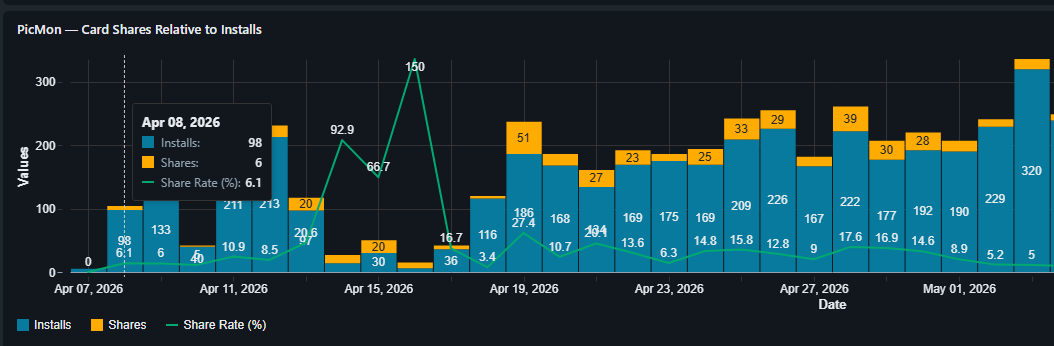
The original version was a collectible card game. Photo to imageGen to card, and then you battled those cards against each other. No world, no exploration, no NPCs. Just the deck.
The creation mechanic was novel enough that players would naturally share what they made, which gave us a healthy K-factor to build on (K-factor being the measure of how many new players each existing player brings in). It seemed to really click with people and CPIs came in around $1, so there was real room to grow.
The Big Pivot: Building a Full RPG
Somewhere in the v1.60s, I made the call to transition PicMon from a card game into a full RPG. Looking back, it was the right move, but it was a significant one.
The codebase picked up an overworld map, tile-based movement, NPCs with quest dialog, grass patches that triggered wild encounters, capture mechanics, healers filling the Pokémon Center role, and a MergeAltar that fused two mons into a stronger child. Battles moved from a card-vs-card UI to a full turn-based system with energy, abilities, status effects, party switching, and blackouts. The CCG roots are still visible in every card's data shape, but the moment-to-moment loop became: explore, encounter, capture, level, evolve, fight the next trainer.
Why change when the original was working well? I wanted more depth and I wanted to push the RUN platform to see what it could actually support. I knew that it was a bandaid that needed to be ripped off early. It also opened up significantly more surface area for deeper monetization and mechanics. This was also the update where I brought on an artist, which turned out to be a great partnership. Learning to vibe code together has been an experience, and a good one. That’s for another devlog, though.
What We've Shipped Since
The v1.250 update was a tone-setter for where the game is ultimately heading. We streamlined the new player experience down to zero popups between create and first battle, added a Dojo narrative arc with curated disciple mons, generated eighteen trainer signature sprites through imageGen, ran balance passes on the wild pool, and introduced a Trainer Level system so veteran players stopped rolling Lv 1 starters. A typed essence economy lets players dust unwanted Mons into power-up currency, and expandable storage gives players a way to grow their collection over time.
My approach to development can be summarized in three words: ready, aim, fire. Moving fast without overthinking decisions allows me to react to player issues and ship the same day. which is almost unheard of outside of critical hotfixes in traditional gaming. Having feedback acted on that fast is a dream that only AI powered game dev can deliver on and it’s something Picmon’s fans react really positively to, even if it means that the game can be a tad unstable at times. Speed matters more than perfection.
What's Coming
The next phase is about turning a solo experience into a community one. That means Guilds, PVP, Events, Animations, and broader Community Features. These are the layers that give players reasons to stay, come back, and bring friends.
The Bigger Picture
The thing I keep coming back to is how rapid iteration results in rapid collection of data. Every change, every pivot, and every feature adjustment has been informed by real data, not opinions.
Play PicMon here and let me know what you think. Catch you on Discord.
Plec - Series 1st Party Developer
Build on RUN · Join the Discord