Turning One-Time Players into Subscribers
Sterf breaks down how to set the hooks, pace the goals, and use reminders to turn those 'one-and-done' players into committed long-term fans (and subscribers).
By Sterf · July 28, 2026
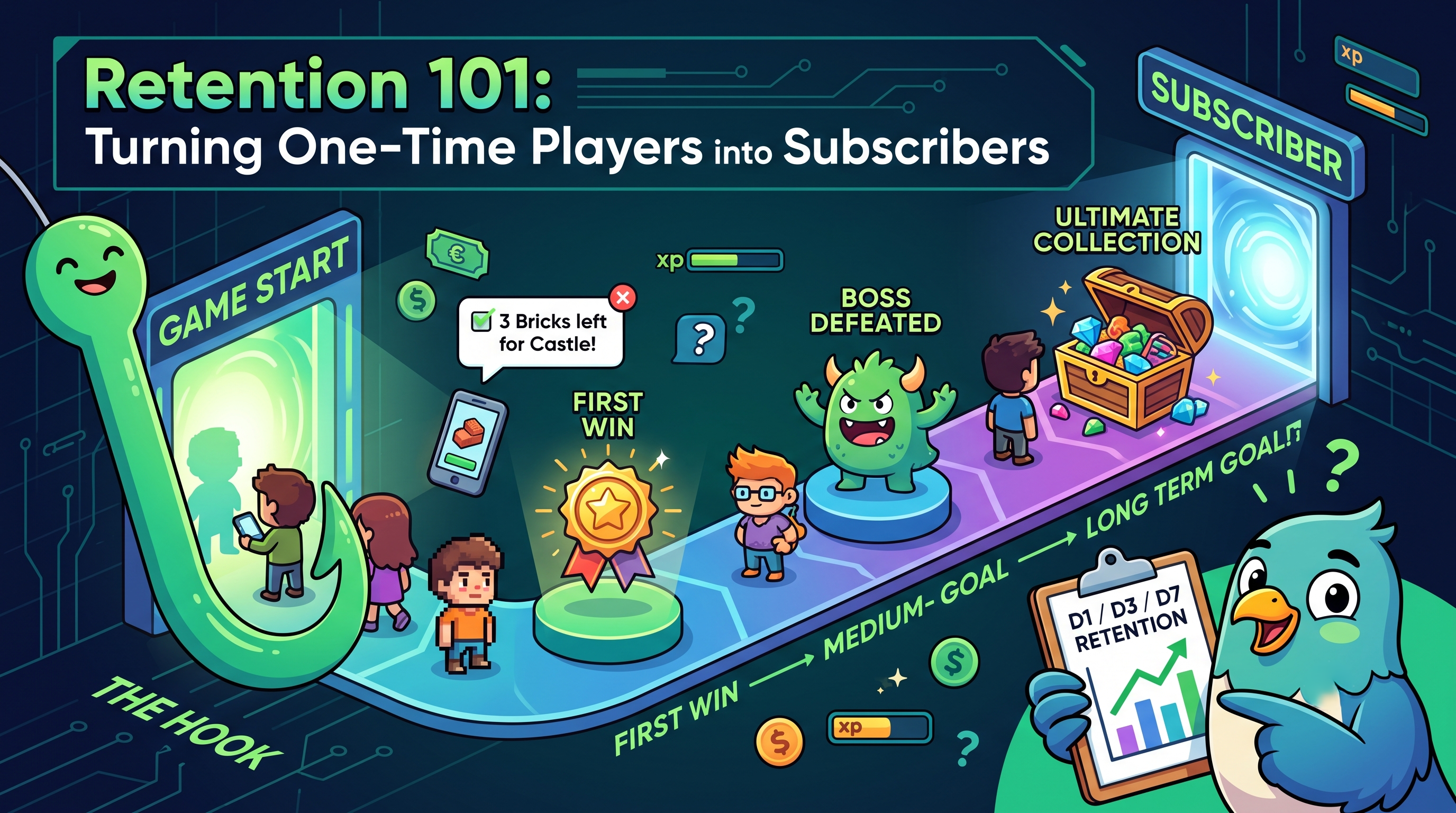
Heyo Sterf here. Today, I want to talk about player retention—often referred to as the 'stickiness' of your game. Put simply, retention is how likely players are to return after their very first session.
🪝The Hook
A player just closed your game for the first time. Why are they coming back?
If the answer is something vague like “because it’s fun” that could be your problem. Giving players concrete reasons to return won't save an unfun game, but it will give you more time to prove to them that your game is fun :)
Reason + Reminder
You have two tools at your disposal when getting players to come back: reasons and reminders. Give them an enticing reason to come back and then remind them. Reminders are a great but it can be easy to just slap them in and not spend enough time on the reasons. So lets start there.
Set a Goal
From the moment a player hits start, your game should lay out a clear path of short-, medium-, & long-term goals that they can work towards. What these goals are heavily depends on your game.
🟢Short-term goals:
These should be bite sized and things the player can complete a number of in a day. This is your core loop - a bunch of these build into your medium-term goals and these should never disappear. This is the bread and butter of your game and it needs to be innately satisfying to do because players are going to do it a lot. If you find these tedious in your testing, your players will too.
First session: Give them a "first win" within a few minutes and leave them on a high. Don’t hit them with too many goals or difficult concepts right out of the gate.
Multiple sessions on Day One: This is your strongest signal for long-term retention. Use short-horizon hooks like timers tied with rewards that mature in 1-4 hours. Pair these with a reminder or notification so they know exactly when to jump back in.
End with a next step: Every time a player closes your game, they should know exactly what they’re doing next. If they don't, you’ve lost them. Avoid the trap of the "endless first session" where they don't know when to stop, or hiding your medium-term goals until "later." Always end on a cliffhanger with a goal for next time :)
Appointment Mechanics
Energy/Stamina: Perfect for arcade, level-based games.
Building Timers: The classic for builders and idle games.
Gacha/Collection: Keeps the RPG and collector crowd engaged.
Leaderboards: Works for skill/score games—but only if you have a social angle.
Limited-time events: Great for broad appeal, but be prepared for the content cost.
🟡Medium-term goals:
These should be presented during or immediately after your tutorial and be completable within a few sessions or a week. Whether it’s your first big boss fight, a new area or mode to unlock, completing a collection, or completing a big upgrade to your base. These goals give your players something to grind toward with the promise that getting there will change the way they play. You want to signboard that this isn’t just a shallow repetitive game, this is your first promise of what’s to come if they continue to play every day. As soon as they complete this goal, celebrate it, and give them a new thing to chase.
Ask yourself: What’s the goal that pulls them back tomorrow because they couldn't finish it today? And when they close the game, are they coming back for more? Tease this medium-term goal during onboarding—retention isn’t separate from your first-time user experience; it’s the same problem.
🔴Long-term goals:
You can think of long-term goals as selling the fantasy of your game - why did someone decide to give your game a shot in the first place and how can you pay that off? This might be “collecting them all”, becoming the strongest, social validation, etc. Keep in mind that long-term goals don't have to be the end. You can keep raising and changing the stakes but these goals will tell your players what they are trying to do and carry them through the short-term goals.
Reminders!
For all the goals you set, you should have reminders in and out of the game that nudge them to come back. Good reminders are specific about what you are working toward.
🚫Come back and play Castle Builders
✅You’re only 3 bricks away from completing your castle!
In game
Simple quest systems is one of the easiest ways to keep that goal front and center for the player. . Don’t make them guess what to do next, especially early on. Put it on the HUD, remind them after each level or encounter what progress they made. Show the bars filling up, check off the completed quests, and show their currencies stacking higher.
If you have features or modes that are serving as your larger goals, show a locked state on the tab or button AND show them how to unlock it. Make sure it's obvious why this feature is cool and why they would want to unlock it.
Out of game
Use local notifications in the RUN.sdk to remind your players to come back. Good reminders are paired with the reason to come back. This could be some bonus currency for returning that kickstarts them into a fun action, r a timer (for building/cooking/hatching something) has finished, their energy has refilled, or their army is healed up and ready for battle again.
The Cadence: Keep it light. 24h / 48h / 72h. If they don't respond after that, stop. You're just noise now.
The Timer: Refresh the timer when they end their session so it hits them exactly a day after they last played.
The Link: Deep-link them directly to the screen they care about. Don’t make them navigate a menu to find the thing you just teased them about.
The Kill Switch: If they complete the task, cancel the notification. Nothing is worse than getting a ping for a reward you already claimed.
Study Comps!
If you’re unsure what might work for your game, do your homework. Pick 2–3 games that actually play like yours—similar core loop, same platform, same session length. Don't just look at "successful games," look at the ones that share your game’s DNA.
For each, break it down: What systems do they use that compel you to keep playing? Daily rewards? Energy? Timers? Events? Leaderboards? Visible long-term progression?
Find the patterns and adapt the ones that work for your game. Map every mechanic you borrow back to your own loop and economy. If it doesn't fit, it’s not for you.
Measure it or you’re guessing
Your retention strategy is only as strong as your data. You can't improve what you don't track. Fortunately, the RUN sdk makes setting up telemetry easy.
What to pay attention to:
D1 / D3 / D7 return rates
Sessions per day / Session length
Notification performance (scheduled vs. opened).
Daily reward claim rates and streak distributions.
Progress toward medium-term goals per session—is that bar actually moving?
Practical note: You need enough players (~50 new users) to read retention and know if your fix actually worked.
Retention is likely something you will want to iterate on a lot. Start your focus right at the beginning of the funnel and work from there. It worth saying - In my experience, if you spend a decent amount of time working on buffing out the bumps in your d1 retention and it still looks rough, your retention is often extremely difficult to change without fundamental changes to your core loop, and it’s worth considering if you should move on to a new project if you find yourself stuck here. Either way there are learnings you can take to your next project :) after all, making great games is often a process of making and remaking again, refining your learnings each time and being unafraid to throw away where you've been to get where you're going.
Happy game making and remember to reach out if you need help!